No Turn On Red

No Turn On Red

Wednesday, October 7, 2020

Tinker Cliffs

This week's Monday Morning Hike was to Tinker Cliffs, a half-mile-long stretch of the Appalachian Trail along the top of Tinker Mountain near Roanoke. Tinker Cliffs, along with McAfee's Knob and Dragon's Tooth, make up the "Triple Crown" hikes in Virginia.

There are two approaches to Tinker Cliffs - the Appalachian Trail or the Andy Layne Trail coming up from the Catawba Valley, meeting the AT at Scorched Earth Gap less than a mile from the cliffs. (The distance is in dispute. The signs say .5 mile, hiking web sites say .7 mile, our "Map My Hike" app measured .9 miles.)

In a photo, these steps don't look very steep, but that's deceiving! After a relatively flat start through a cow pasture and over two creek crossings, the Andy Layne trail ascends steeply for about a mile before getting to switchbacks that make the trail grade much gentler.

We had a pleasant walk through early-fall woods.

A bent tree provided a rest "bench". It reminded us of a bristlecone pine (but it isn't!).

Mushrooms growing in a hollow stump.

As the trail gets near the summit, it goes beside/beneath small rocky cliffs.

Tinker Mountain has a flat top, with a set of cliffs on the western side.

The view up the Catawba Valley. McAfee's Knob is the closest mountain, at the left.

The cliffs have a 180° view to the west.

USGS benchmark marking the summit.

We made it to the top! It was breezy and much cooler up here, so we had to put our jackets back on.

Rocky ledges are favorites of timber rattlesnakes. We left it alone, and it left us alone!

Tuesday, October 6, 2020

Recent Wildlife

There's plenty of critters in the woods.

Even coyotes (eyes, background) stay away from skunks!

This coyote has become a regular visitor to the far end of our "meadow" (aka septic drain field). It becomes particularly vocal when Dakota (our aging dog) gets near. We suspect it is protecting a den. I don't know if it is the same coyote we saw down there about this time last year.

This edge between the forest and the meadow is also popular for deer. This four-point buck has eluded hunters for at least three years.


Saturday, October 3, 2020

Quite a Year for Mushrooms (Fungi - Part 2)

 More of this year's Fabulous Fungi.

Bracket or Shelf Fungi


There are several species (or perhaps, subspecies) of brightly colored "sulphur shelf" fungi, Laetiporus sulphureus


Cinnabar-Red Polypore (Pycnoporus cinnabarinus).


"Turkey Tail" fungus has been vigorously attacking logs and stumps for the last two months. I think these are mostly Trametes versicolor - complete identification would require a close examination of the pore surface, and these are just too beautiful to pull apart for a look. (The background in the photo is shale ridges in a stream bed. The fungus is so dense that the log it is growing on is barely visible.)
Some of the "tails" get up to 6 inches (20 cm) wide.
A closer look at the multi-colored bands.


Tooth Fungi


The shaggy Lion's Mane fungus (Hericium erinaceum) was a startling find. Its Latin species name means "prickly" or "hedgehog-like". It does somewhat resemble a hedgehog!


Club Fungi


The Elegant Stinkhorn (Mutinus elegant) is unmistakable. Sometimes it has other names, courtesy of its resemblance to mammalian reproductive parts - the botanical family is Phallaceae. The smelly slime layer (it is a "stinkhorn") attracts insects for spore dispersal.


Swamp Beacons (Mitrula elegans) love to grow in wet areas in spring.


Coral Fungi


It seems that this year featured a larger than usual number of coral fungi. Normally I see an occasional coral fungus. This year many trails were lined with coral fungi.

In late August and early September, the Straight-branched Coral fungus (Ramaria stricta) was everywhere. Clumps like this stretched for 20 or more feet along trails.


Crested Coral fungus (Clavulina cristata).


This large fungus is called the Cauliflower Mushroom (Sparassis crispa). When young, it is a prized edible (but I didn't try).


Jelly Fungi


Witch's Butter (Dacrymyces palmatus - because it's on conifer wood) infests our deck rails - even though they are supposed to rot-resistant western cedar. We'll be replacing our deck railing sometime in the next year.
The fruiting bodies pop up whenever it rains, but hide during dry days.


Cup & Bird's Nest Fungi


Common Brown Cup fungus (Peziza badioconfusa)


These are much older photos, but Bird's Nest fungi (Cyanthus spp.) are so different that I couldn't resist adding them here.

When we first tried to landscape around our house, we got lots of shredded wood mulch. These tiny fungi (about 1/2 inch, 1 cm) grew abundantly, but were only visible if you looked for them. They start out entirely enclosed (puffball-like fungus), then open up into the "nest" with "eggs" inside. These are most likely Cyanthus stercoreus. (2012 photo)
A different species, most likely Cyanthus striatus. (2011 photo)


Quite a Year for Mushrooms (Fungi - Part 1)

 August, and especially September, have provided us with an unusual number of fungi. I took photos of over 50 different species, but haven't been able to identify most of them - I'm no fungus expert!

This post features gilled mushrooms. The next one covers everything else.


I'll start with one of the most spectacular mushrooms in the woods, the Jack O' Lantern Mushroom (Omphalotus illudens). Over the years, I've probably photographed this fungus more than any other.
The large orange clusters are real attention-getters. I've tried, but I've never been able to see the bioluminescence that accounts for the name.


The "Death Angel" or "Destroying Angel" mushroom (Amanita virosa) is one to know (and avoid!). It is among the most poisonous mushrooms.
It starts out as a small rounded knob.


The Parasol Mushroom (Macrolepiota procera) is common in the grass near our house. I pulled another one from the grass just outside our house to take a closer look (and a spore print). (Left photo from 2005.)

A closer look at the cap.
The underside of the cap. The ring on the stalk is actually free of the stalk and can be moved up and down.
When the Parasol Mushroom first emerges, it looks like a tympani ("kettledrum") stick. (2006 photo)


Black Trumpets (Craterellus fallax) are relatively common, but so well camouflaged that they are rarely seen. Most of the time I've seen them, I've been crawling around on the forest floor during the Field Ecology Governor's School forest studies (scroll down to the bottom of the link).
A look down the "trumpet". Despite their alternative name of "Trumpets of Death", they are edible. (But I haven't tried!)


Golden trumpets (Xeromphalina kauffmanii - growing on hardwood) have a similar shape, but are easier to see.


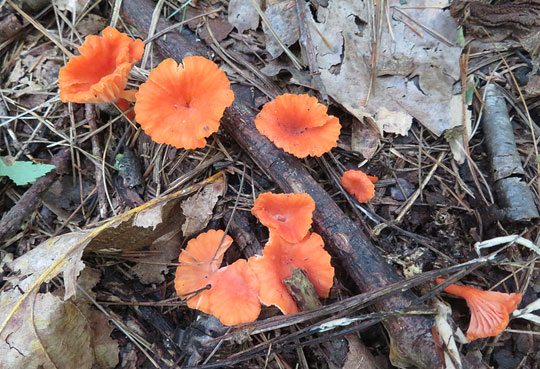
Not quite a "trumpet", the bright orange Cinnabar Chanterelle (Cantharellus cinnabarinus) also have a funnel shape.

I have far more unidentified mushroom pictures than I have identified ones. Here are some of the more interesting.

This emerging 'shroom looks like it belongs on a chess board.


This mushroom has very spiky warts on its cap.


I've photographed this red-yellow mushroom for years, but have never identified it.


The penny shows how small these mushrooms are.


And finally, a mushroom movie from 2012.

Inky Cap mushroom dripping (30 sec time-lapse). The mushrooms appear and "dissolve" in one day. I'm not quite sure which Coprinus species this is.