No Turn On Red

No Turn On Red

Wednesday, March 15, 2017

Snow - Finally!

Until yesterday it was an almost winterless winter. But we got a bit of snow overnight:

That big, gloppy, heavy snow that covers every branch. About 3 inches fell.
But what a difference an hour made. As the temperature approached the freezing point and the winds picked up, all the snow came off the trees. No where near as "magical" now!
By the afternoon, the snow was gone, but the temperature eventually dropped to 13°F (-10°C) with windchill below 0°F (-15°C). Cold!

Monday, March 13, 2017

Birds

I started this post last summer (June 2016), but with only two birds, wanted to wait for more. Now I have more!

June 2016:

Indigo bunting
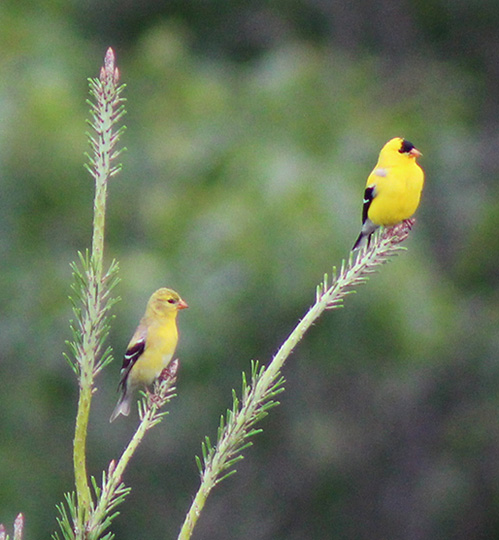
American Goldfinch. Female on the left; male on the right.
March 2017:

The Great Blue Herons have returned to their rookery in a river-side sycamore tree.
And our resident cardinal still doesn't know the difference between his reflection and an intruder. Here he is attacking himself in the back window of our pickup truck.
We have a large flock of turkeys in our woods. We've seen about 20 at one time.
Song sparrow
This "tree cookie" shows a cross-section of a red maple showing evidence of repeated visits by Yellow-bellied Sapsuckers (a kind of woodpecker). The tree was about 75 years old when it fell down. It looks like it was visited by sapsuckers in at least 7 times, with about 5 to 10 years in between visits.

Friday, February 3, 2017

Out & About

Earlier this week we finished our second woodshed.

Sue & dogs in the new shed.
And we need it -- Lon has more wood to split.
Lon and both dogs -- you can just barely see Sadie's head behind Dakota.
We've had a red-shouldered hawk in the neighborhood for a few years now.
But now it appears we have a pair.


Sunday, January 22, 2017

Pittsburgh - Duquesne and Monongahela Inclines

Two inclines travel up Mount Washington from Carson Street (bottom) to GrandviewAvenue (top) -- about a 400 ft (120 m) climb. On our "urban hike" in Pittsburgh we went up the Duquesne Incline and down the Monongahela Incline.

The Duquesne Incline. Note that the incline cars are "flat". The Monongahela Incline has a different design.
Incline car in the upper station.
All the machinery to operate the incline is in the upper station. It's all original equipment that has been running for more than a century.
The upper station.
An iconic view of Pittsburgh: the Point and downtown with the Incline in the foreground.
Not quite a mile down Grandview Ave is the upper station for the Monongahela Incline.
We got a front-row seat for the return trip down Mt. Washington. Here we're getting ready to pass the car going up.
Cars on the Monongahela Incline. Note that these are "stepped" cars, unlike the flat ones on the Duquesne Incline.


An Urban Hike through Pittsburgh

After a cold, rainy week, yesterday's weather was downright balmy for January (65°F, 18°C). We took a 10-mile hike through Pittsburgh: South Side, the Point, and Mt. Washington, then returning to the South Side.

We started on the South Side and took the GAP/River Trail to the Point. This is the Liberty Bridge across the Monongahela River.
A view of the Fort Pitt bridge as we crossed the Mon on the Smithfield Bridge.
The Fort Pitt Bridge from the Point. Entering Pittsburgh through the Fort Pitt Tunnel displays one of the most dramatic cityscapes in the world. It's a total surprise the first time you come through -- even better if it's at night. (If you can't get to Pittsburgh in person, you can see this view in the 2012 movie The Perks of Being a Wallflower.)
From the Point, we walked across the Fort Pitt Bridge (didn't know you could do that!) to the Duquesne Incline. (An "incline" is a "funicular" for those who are more familiar with European terminology.) The next post will be about the two inclines on Mount Washington.
A view of downtown and the Mon River from the top of Mt. Washington. The yellow bridge is the Fort Pitt Bridge. The next bridge to the right is the Smithfield Bridge. It really is a spectacular view.
A view down the Mon from Mt. Washington. The left-most bridge is the Smithfield Bridge, followed by the Panhandle Bridge (trolleys only), the Liberty Bridge, the 10th Street Bridge (yellow), and the Birmingham Bridge (blue) in the distance. A coal barge is heading downriver.
A view the South Side from Mt. Washington. The Liberty Bridge is in the foreground.
St. Mary of the Mount is a prominent feature of the Mt. Washington skyline.
The owners of this duplex couldn't agree on a color scheme, so it's divided right down the middle.
Look closely, and you can see that this is one of Uber's self-driving cars -- the sensors are mounted on the roof of the vehicle. Pittsburgh is the test site for Uber's efforts in this field.


Pittsburgh - Bicycle Heaven

Three Weeks, Three Kids

In the past three weeks, we've been able to visit all three of our children (Naperville, IL; Laurel, MD; Pittsburgh, PA). This week we've been in Pittsburgh. Most of the days were cold and rainy, so it was a good week to check out "Bicycle Heaven", a bicycle shop (repairs, rentals, sales) that has turned into an impromptu and extensive collection of bicycles, bicycle parts, and memorabilia. Calling it a "museum" implies some sort of curation; while some of the bikes have informative notes, many do not. Bicycle Heaven's large collection of period bicycles makes it the go-to bicycle source for Hollywood.

The collection fills two floors (and walls, and ceilings) in a nondescript industrial building in Pittsburgh's Manchester neighborhood. Unfortunately, the pickup truck with snowplow pulled up as we got out of our truck, and was still there when we left, so I couldn't get a nice photo of the exterior.
The oldest bicycle in the collection: everything is made from wood except the metal rims. It is affectionately called the "Boneshaker".
Among the most unusual, rare, and valuable bicycles in the collection, the Bowden Spacelander had a frame and fenders made entirely from fiberglass. The bicycle debuted in 1960, but less than 600 were made. Today they are collectors' items worth tens of thousands of dollars.
Parts Galore! The left photo shows a wall of chain guards (mostly Schwinn, mostly organized by color). The right photo shows a wall of front forks (again, mostly Schwinn and and mostly organized by color). In general, the Bicycle Heaven probably includes almost every Schwinn bicycle model ever made. It also has a large selection of Huffys. European and Asian bikes are few.
Bicycle Heaven's parts collection includes a large number of "Original Factory Color" Schwinn paints.
A baseball bat holder on the rear of a Schwinn "Grey Ghost" Sting-Ray bike.
It's not all serious collecting. This black-light-lit room has a bicycle and hundreds of cranksets painted in phosphorescent paints. A true throwback to the 1960s. (David says I'm making sure this blog is Y2.1K compliant!)
The "tree that ate two bicycles" was found in rural Ohio. Where else but Bicycle Heaven could such an item end up?


Saturday, January 21, 2017

Air and Space Museum - Udvar-Hazy Center

Last Friday we had to go up to Dulles Airport (Chantilly, Virginia -- near Washington, DC) for Lon to finish his Global Entry application. (Now we both have expedited re-entry to the U.S.) While there, we finally took the time to visit the Air and Space Museum "annex" next to Dulles Airport -- officially, the Stephen F. Udvar-Hazy Center.

The museum is three gi-normous hangars -- one for aviation, one for spaceflight, and one for restoration. We spent about 2 1/2 hours to get an feel for the museum. To see everything would take a full day.

With hundreds of planes and thousands of artifacts it takes a long time just to walk through once, much less really spend time at each section.
This aerobatic plane is displayed upside-down.
The Fulton "Amphibian" plane was designed so that the cockpit could become a road vehicle. James Bond aside, the concept was never successful because both the plane and the car had too many compromises.
An early Lufthansa passenger plane.
The Concorde (supersonic passenger plane), with an early PanAm passenger plane in the lower-right foreground.
As might be expected, there are a large number of military planes. This is the Enola Gay -- famous (infamous?) for the first use of an atomic weapon in the bombing of Hiroshima, Japan, in World War II.
The Lockheed SR-71 "Blackbird" stealth reconnaissance plane.
The SR-71 has a prominent location in the middle of the main hangar, in front of the space hangar. This photo also gives you a sense of the size of the museum.
In addition to manned spacecraft, there is a large collection of satellites -- mostly mock-ups used while designing the real things, which mostly are either still in space, or have burned up in the atmosphere.
It's nearly impossible to get a photo showing the entire space shuttle. This is the best I did.
The shuttle's rear engines.
A head-on view of the shuttle and the space hangar.