No Turn On Red

No Turn On Red

Thursday, July 19, 2018

Gator

It's a total splurge, but today I got my long-coveted John Deere Gator.

Front view. We added a windshield, roof, and back grate.
We'll use it mostly for road maintenance and collecting brush and firewood.
Action shot. Turns out I really miss rear-view mirrors when backing up! We checked it out on most of the roads/trails on our land.
Two more action shots caught by our game camera.
Getting the mail.
Lon loves the dumping bed.


Lightning Strike

When we came home from a weekend in Alabama, we found a shattered tree near our road.

The debris on the ground was what first caught my attention. The odor (aroma?) of "freshly-cut" oak was strong.
Then I looked up and found the damaged tree.
It must have been a glancing blow, since the damage started below the top of the tree.


Monday, July 9, 2018

Viewshed Maintenance

Lon has been working hard to restore the view from our deck.

1 July 2018. Small pines and black locusts grow quickly and block the view of our meadow (aka septic drain field).
8 July 2018. Lon left the two persimmon trees and a few oaks. Next he'll mow the meadow to stimulate the growth of grass and cut down black locust seedlings and the inevitable blackberry growth. Unfortunately, small trees don't make for much firewood.
11 July 2018. Lon has cleaned up the logs (see below) and mowed the meadow.
Most of the trees Lon cut down were black locusts. Here's his nicely-sorted log pile - with a few chestnut oaks in there as well. Firewood for next year.


Wednesday, July 4, 2018

This 'n' That

I've been so busy with the Field Ecology Summer Regional Governor's School, that I haven't taken any time for a blog post. But things have been accumulating, so here goes...

Today one of my favorite wildflowers, Indian Pipe (Monotropa uniflora), started popping up in our woods. As in the past, when Indian Pipe comes out, there are many patches that emerge simultaneously.
Two days ago there was a lot of moisture in the early morning air, ...
... and there was a rare morning rainbow in the southwestern sky.
The moisture put tiny pearls of dew on spiderwebs. This web has clearly seen better days!
The pine trees were particularly heavily coated with spiderwebs. I'm pretty sure these are webs of the basilica orb weaver spider (Mecynogea lemniscata). We've seen egg sacks of these spiders in Virginia Pines we have cut for Christmas trees.
Back in May, carpenter bees had made holes in the post that holds our wildlife camera. This week it appears that a pileated woodpecker found the contents (bee larvae?) of at least one hole a tasty treat. Given how the woodpeckers have attacked our gatepost, we may soon have to find a different post for the camera. (It's on this post because the tree it was originally on blew down several years ago.)
And finally, it continues to be a good year for snakes.  Last month Lon saw this good-sized timber rattlesnake near our woodsheds. Earlier this week we found two snake skins in the woodshed while moving firewood to our deck.
They're a bit blurry, but you can clearly see the triangular head (left) and rattles (right).


Saturday, May 26, 2018

Critters - Mostly Small and Smaller

I'll skip the ubiquitous ticks we pull off ourselves after every walk, and get right to the interesting stuff.

Tree Gnomes

When we returned from our recent road trip, one of our "tree gnomes" had sprouted a new look.

The "tear" falling from the gnome's left eye is a small hornet nest.
A side view showed it was far off the vertical. Fortunately, it appears that the hornets didn't like this location -- the nest was empty, and we removed it from the gnome's eye.

Opossum

It's relatively rare to see a 'possum during the day, but this one was out and about today.

The 'possum was strolling ('possums never move fast!) across a grassy area near our property gate. 'Possums are not particularly attractive animals! They look like they are a large rat, but they are marsupials (mammals with pouches to hold their young) and mostly live in trees.
On our return from the mailbox, the 'possum had moved about 50 feet to feast on garbage dragged by a bear onto our land from our neighbor's trash bins. Although this was the first sign of a bear this year, earlier today we thought we had heard a bear crashing through the woods.

Box Turtles

I think box turtles are much cuter than 'possums.

This female turtle was near our woodyard. I've documented her there twice before in 2013 and 2017.
This turtle was visiting our compost bins last June. As I mentioned in an older post, I've been documenting box turtles on our property since 2009. I'm almost up to 50 individuals.
It looks like the compost-bin turtle had also been eating blackberries!
And tooth marks on the carapace (shell) shows evidence that a predator (bear? coyote?) tried to eat it.

Snakes

It seems to me that we've seen more snakes this year than usual.

Last week, Dakota (our dog) stepped on this black rat snake laying across the trail, and the snake did not approve.
Today it was my turn to almost step on this copperhead. Fortunately, I saw it in time to prevent stepping on it, and the snake was watchful, but unperturbed.
A comparison of heads shows the difference between venomous and non-venomous snakes in our area. Venomous snakes (top photo) have triangular heads and vertical slits in their eyes, while non-venomous snakes (bottom photo) have very little, if any, constriction behind their jaws, and circular pupils in their eyes.


Saturday, May 19, 2018

Around the Hollow

Observations of the past week-or-so.

Lon built a bridge across a small stream. We probably should have used 16-ft beams, but carrying 12-ft boards is about the limit for our 6 1/2 ft truck bed.
Pink azaleas are in bloom.
Indigo buntings (left) and eastern bluebirds (right) like to sing from the tops of the trees.
The blueberries are blooming, and this unusual lady beetle was checking out the flowers.
Our trail camera is mounted on this post. The sawdust at the bottom attracted our attention. It appears that carpenter bees have decided that this post will make a nice home.
Pileated woodpeckers, not carpenter bees, are responsible for attacking this stump. The stump has served as out gate post, but it may not be around much longer! The woodpeckers started hollowing it out in February and have pretty much demolished three sides. I moved the trail cam to see if we could get some pictures, but it didn't record any woodpeckers.

Thursday, May 17, 2018

Dusty Jeans & Genes - Part 30 - Playing with 3D Images

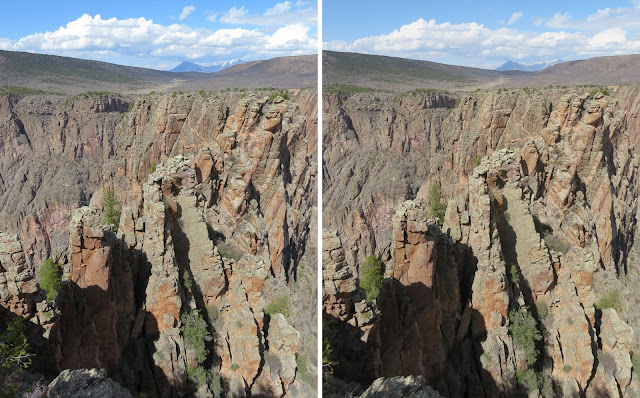
I've been playing with trying to make "stereo vision" photos. Most people have depth perception because our eyes are a few inches apart and thus see things from slightly different angles. The brain merges these into a 3D image. If you take two photos from slightly different angles, you can use these photos to get a 3D image. I have to use a stereoscope to do this, but some people can do it without the aid of lenses. The "View-Master" toy operates on the same principle.
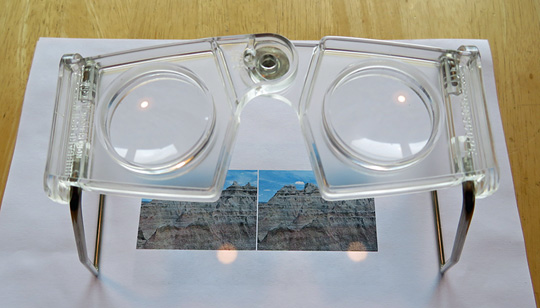
An inexpensive stereoscope.
Below are two examples. I took the left image of each pair, then stepped to the right about a foot and took a second photo. Because I didn't use a tripod, I aligned the two images in Photoshop Elements, and set the width at 5 inches (details of the method are given at the end of this post). The printed photos popped into 3D.

To see how this works, right-click (control-click on a Mac) on an image below, and save it to your computer. Print it, making sure the width is 5 inches. Then use a stereoscope to view the image.
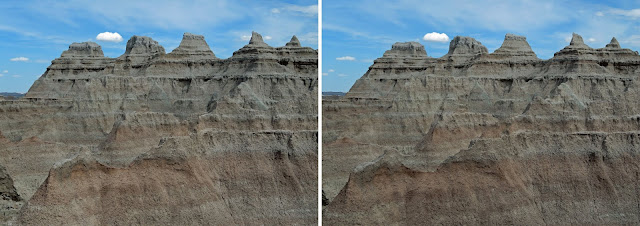
Badlands National Park
Black Canyon of the Gunnison National Park

More details on aligning the photos in Photoshop Elements:

  1. Copy the second photo and paste it on top of the first photo. This creates a second layer.
  2. Change the opacity of the top layer to about 50%.
  3. Drag the top layer to align the middle of the horizon in both photos. The center of the photos should align well, but as you view to the left or right, you will notice that the two photos do not completely align. This is because the photos were taken at slightly different angles. The horizon will be largely unaffected, but the closer the object, the greater the discrepancy.
  4. Change the opacity of the top layer back to 100%.
  5. Crop the photo as desired. You at least want to make sure there is no "blank space" in either of the layers.
  6. Use "Canvas Size" to make the canvas just a bit wider than twice the photo size. Also make sure that you click to align the image with the left edge of the enlarged canvas. This will create a large "white space" to the right of the photo.
  7. Drag the top layer to the right side of the canvas. This should leave a small white bar between the two photos.
  8. Use "Image Size" to make the width 5 inches with a resolution of your choosing, but at least 300 pixels/inch. (I had to play around with the size, and found the best results with a printed width of 5 inches. Your stereoscope - and eyes - may vary.)
  9. Print the photos at actual size. (Sometimes you can just use the stereoscope on the computer screen. I've had success with this in the past, but not with these photos.)
  10. View with stereoscope.